Not long ago, I discovered the practice of infrared (IR) photography. It is a fascinating practice that allows IR light to pass through the camera and onto the final print. The results are generally very unexpected and have an almost haunting quality to them. If you shoot color, you notice that some objects look normal, while others reflect either the wrong color or shift to black and white entirely. In black and white, you notice extreme shifts in the intensity of the black or white values (or black/white inversions altogether), producing a print that is often extremely high contrast. Naturally, discovering this process got me really interested in figuring out how to achieve experimental IR prints without buying a bunch of extra gear.
A precursory search revealed many modifications you can make to a standard digital camera to allow the camera to capture infrared (namely the removal of IR blocking filters and installation of replacement blue filters to allow IR sensitivity). But, as someone who just owns a couple of analog camera bodies and a fridge full of film, I was wanting to see what IR capabilities a film camera could have. After checking around, the process seemed extremely simple; all you needed was an infrared filter for far red wavelenghts (720 nm or so) and IR sensitive film. As it turns out, there are a few film stocks with IR sensitivity including Ilford SFX 200, Rollei infrared, and Dracula to name a few. Coincidentally, I’ve had a roll of Dracula 60 sitting in the back of my fridge for months and had no idea it was IR sensitive, so I opted to experiment on it with IR. All of the images below were taken in Moab, Canyonlands National Park, and Arches National Park using my OM-1N. None of the images have been edited.
Extremely High Contrast
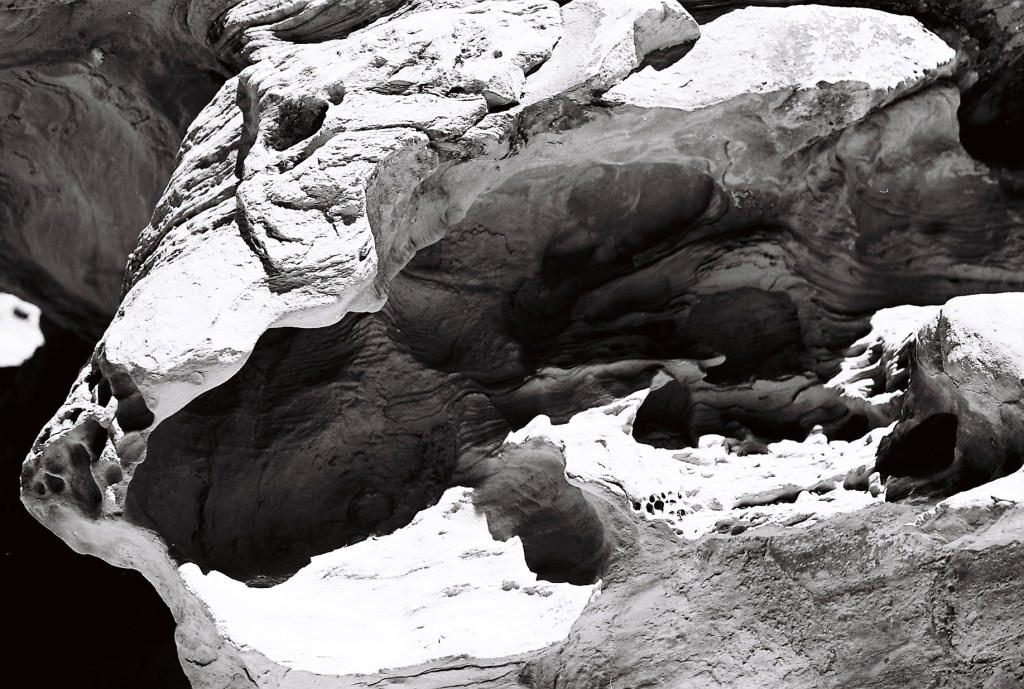
After checking the results from the roll of film, I noticed that the BW images that I took were much higher contrast than usual. This is likely due to the camera capturing more light than expected in some images because of its ability to collect light non-visible to us. In the print below (which was just a photograph of an interesting red boulder I found in the Big Bend Bouldering area) the BW contrast is extremely skewed from what it should have been due to capturing IR light, which makes it challenging to determine what the subject of the image even is. The result is a very interesting image, impossible to discern any details and offering no place for your eyes to rest.
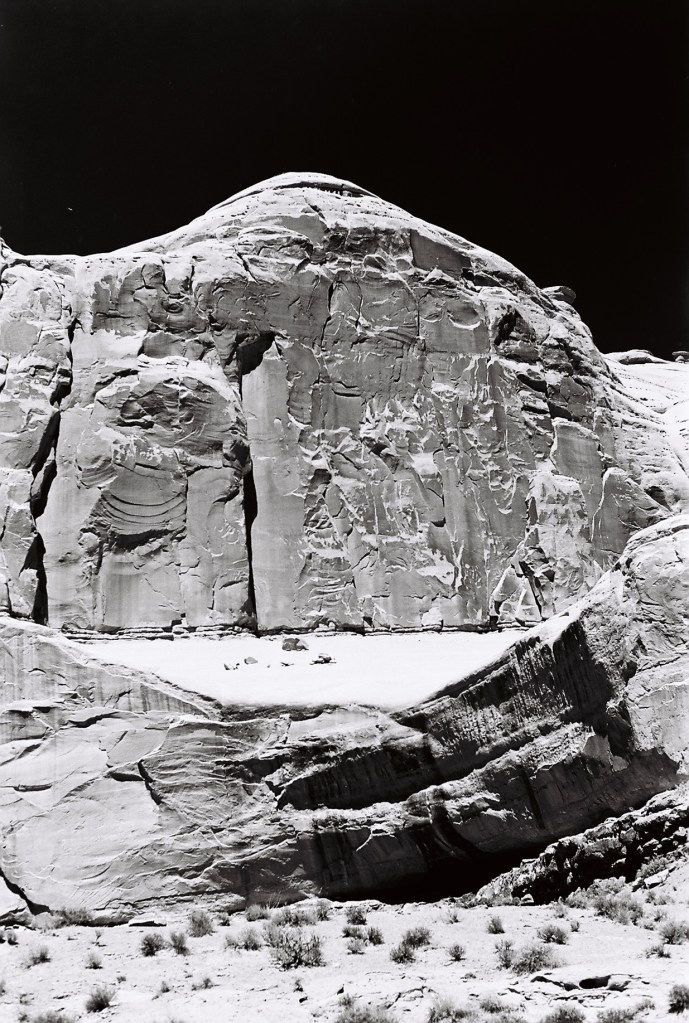
In addition, some subjects such as my fiance’s dark green car become extremely contrasted to the brightly-shifted foreground/background. I think this is because the gray value of the road has shifted far brighter than it should have been, making the car appear to be far darker than it actually is.

Dark Skies
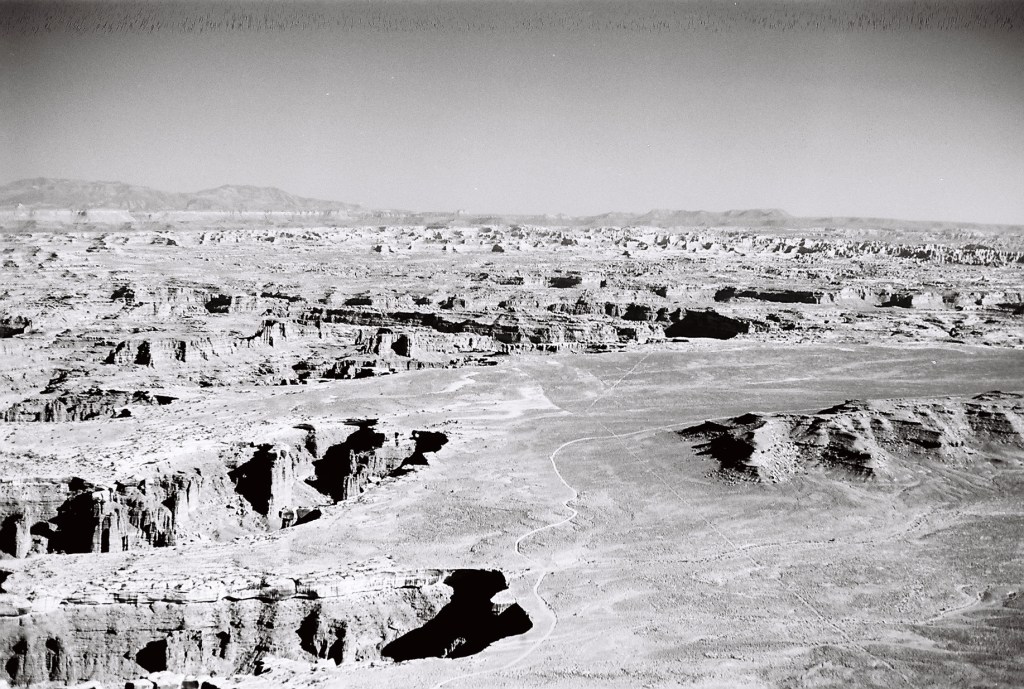
Another trend I noticed was the tendency for the skies to shift very dark (even on prints taken in broad daylight). While this wasn’t apparent on every image I took on the roll of film, I did see this effect a couple of times. The resulting image feels eerie, almost as if the image was taken at night but the lighting is all wrong.
As a side note, our local dark room for BW film development is often quite messy, leading to apparent dust or debris on the scans we receive. This is an extremely annoying phenomena sometimes, but actually led to a very interesting image below, where the debris appears as stars against the darkened sky.

General Ethereal Qualities
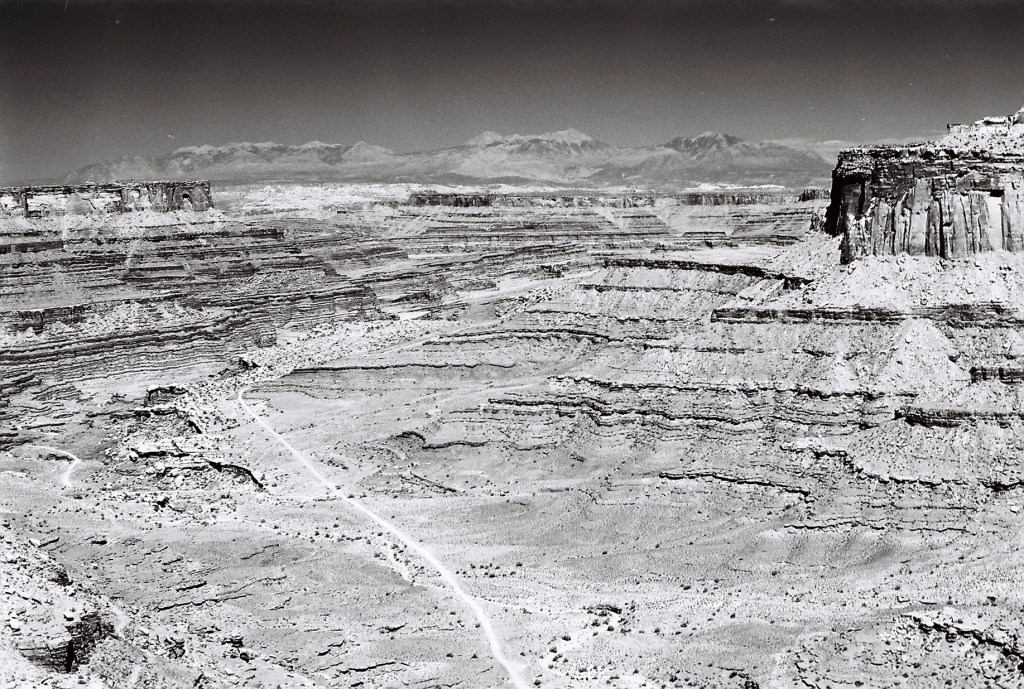
Due to the extremely intense 720 nm filter I was using to achieve infrared images which caused me to lose 3+ stops, I opted to ditch my UV filter to try to gain back a little bit of control on my camera. Keeping that in mind, I noticed a bit of a ‘otherworldly’ and vignetted feeling in a couple of my images that featured subjects very far away. My hypothesis is that the extremely contrasted nature of images reduces the information about the subject in the final print. This causes a slight feeling of uneasiness, confusion, and disorientation.
Additionally, some subjects such as the mountains in the far background below, pick up an eerie glow against the dark sky.
Conclusions and Future Work
Honestly, I had a lot of fun dissecting these images after getting the scans of the negatives back. I had really low expectations for this experiment, but feel like I got some awesome prints back. In terms of shooting the images, however, I had a horrible time. The 720 nm filter aggressively obscures the viewfinder, rendering it very challenging to take an accurate shot. It feels like shooting through a sheet of welding glass, even in the hot, UV-intense Moab sun. Because of this, I will reserve IR photography for rainy days (or projects where it is the best tool for a print). If I could go back and do it again, I would ditch the Dracula film for something with a higher Iso such as Ilford SFX 200 to compensate for the drastic loss in stops caused by the 720 nm filter. Additionally, I would like to do this again in color, but the IR color film stocks are all either discontinued or really expensive (like 50 dollars or more per roll). Maybe a company will release a new color IR film soon due to the heightened interest in analog photography.
 Second Arrow